

Need a part right now? Submit an RFQ on Aviatrading and reach verified sellers worldwide.
Introduction
In aviation procurement, the choice between PMA parts and OEM parts is an important decision for airlines, MRO providers, operators, and aircraft parts buyers. Both options can play a valuable role in aircraft maintenance, but they differ in cost, sourcing strategy, availability, certification, and buyer perception.
As supply chain pressure, long lead times, and rising maintenance costs continue to affect the aviation industry, many organizations are paying closer attention to approved alternatives. PMA parts are one of the most discussed options.
Understanding the difference between PMA and OEM parts helps procurement teams make better decisions while maintaining safety, compliance, and operational efficiency.
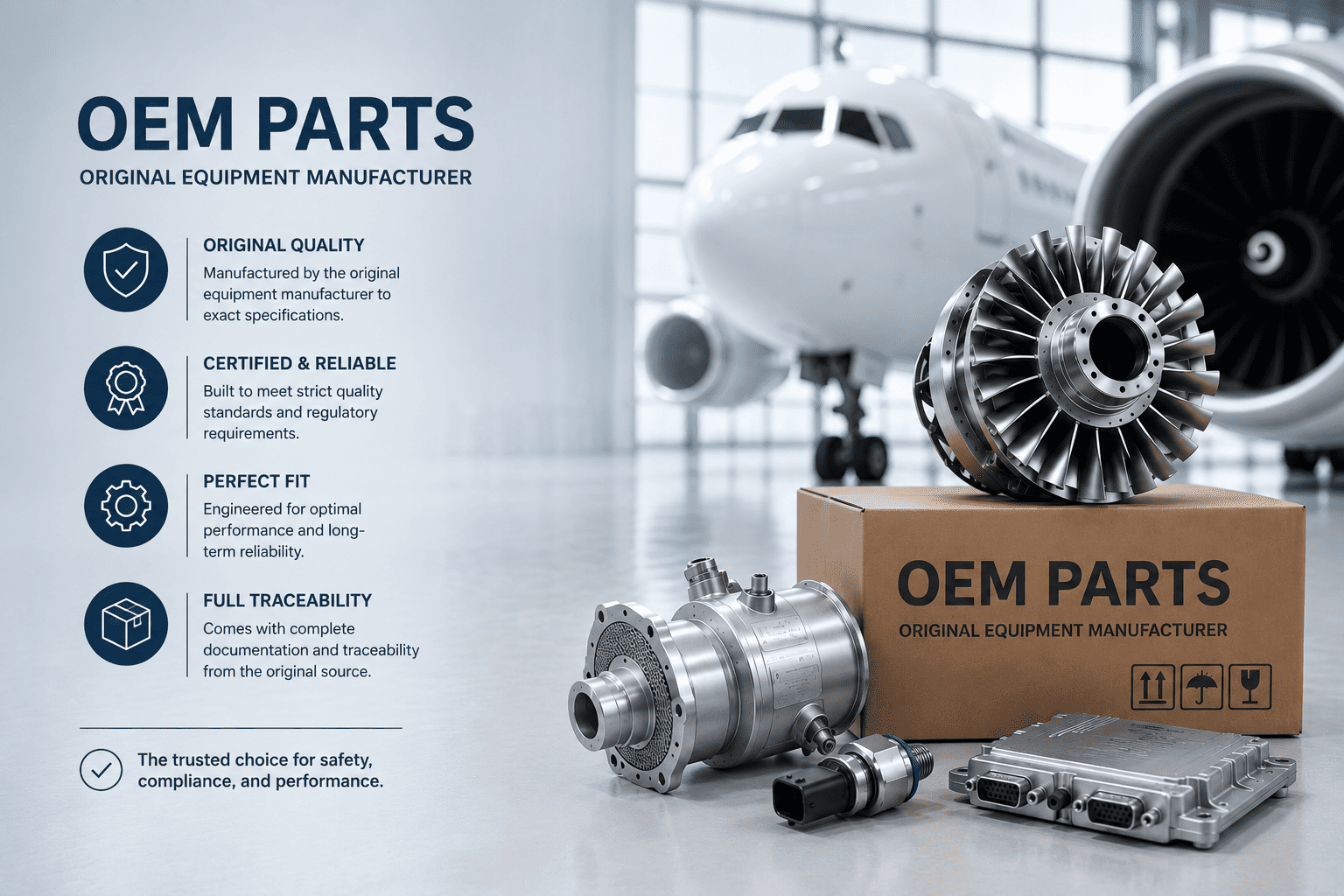
What Are OEM Parts?
OEM stands for Original Equipment Manufacturer. OEM parts are produced by the original manufacturer of the aircraft, engine, system, or component, or by an approved supplier within the OEM’s production network.
These parts are typically associated with the original design and production approval of the aircraft or component. For many operators, OEM parts are the default choice because they are widely recognized, supported by the original manufacturer, and often included in maintenance manuals, warranty programs, and approved parts catalogs.
OEM parts may be preferred when:
- The aircraft is still under warranty
- The operator has a long-term OEM agreement
- The part is highly complex or critical
- Internal policy requires OEM sourcing
- The buyer wants maximum manufacturer support
However, OEM parts can also come with higher prices and longer lead times, especially during periods of supply chain disruption.
Source it on Aviatrading
Verified sellers, documentation attached to every listing, and every transaction protected by escrow. You pay only when a deal closes.
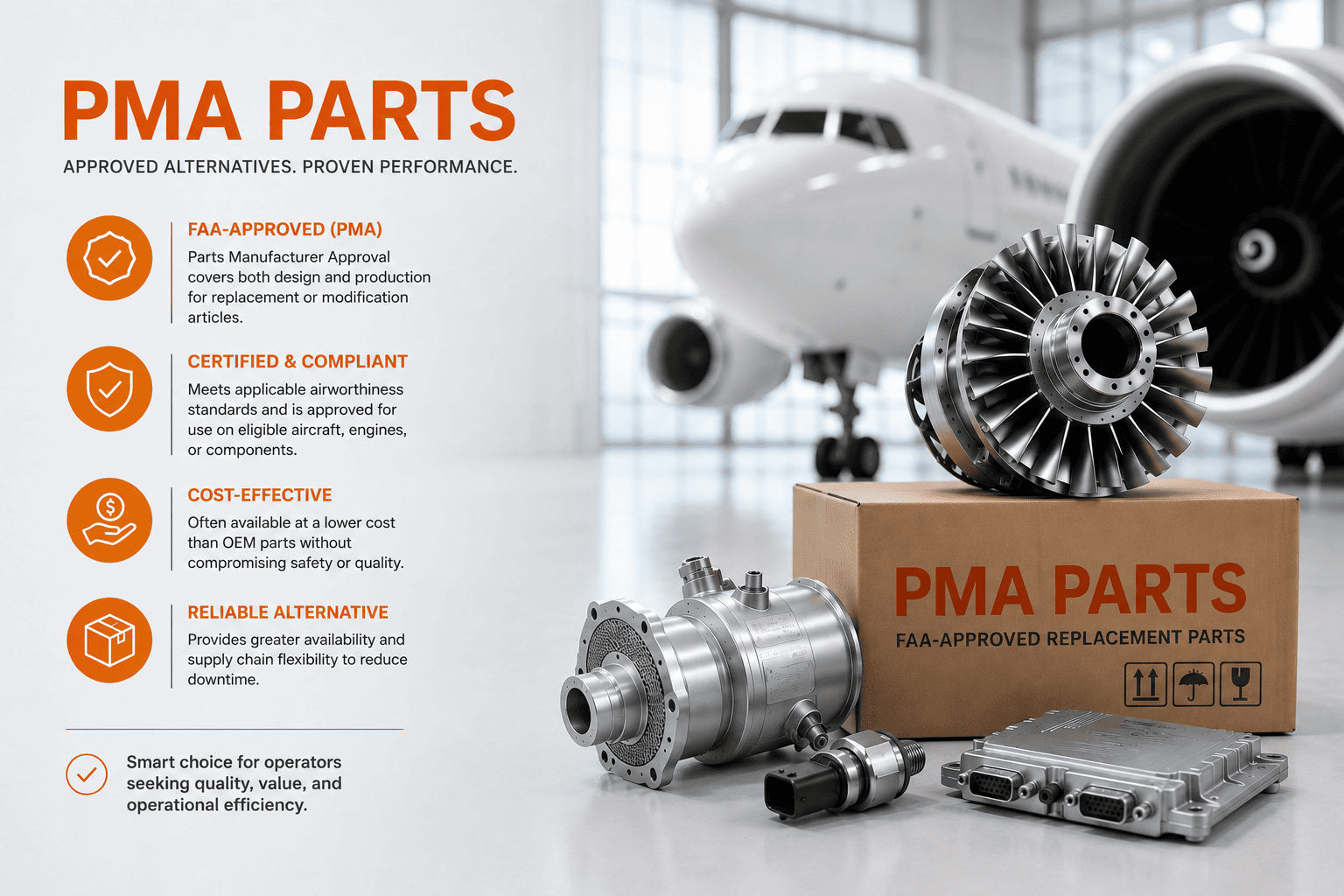
What Are PMA Parts?
PMA stands for Parts Manufacturer Approval. A PMA part is a replacement or modification part that has been approved by the aviation authority, such as the FAA, for use on a type-certificated aircraft, engine, or propeller.
PMA approval covers both the design and production of the part. This means the manufacturer must demonstrate that the part meets applicable airworthiness requirements and can be produced under an approved quality system.
PMA parts are not simply “copies” or uncertified alternatives. They are regulated aviation parts that must follow a defined approval process before they can be installed on eligible aircraft.
Depending on the approval path, a PMA part may be based on identicality, licensing agreements, tests and computations, or other approved data.
Cost Comparison: PMA vs OEM Parts
One of the main reasons buyers consider PMA parts is cost.
In many cases, PMA parts can be more cost-effective than OEM parts. This can help airlines and MRO providers reduce maintenance expenses without compromising compliance when the part is properly approved and documented.
Cost advantages may come from:
- Lower manufacturing overhead
- More competitive supplier pricing
- Reduced dependency on a single OEM source
- Alternative production methods
- Greater aftermarket competition
For high-volume replacement parts, even modest price differences can create significant savings over time.
However, cost should not be the only deciding factor. Buyers must also consider part criticality, documentation, warranty impact, installation eligibility, and internal approval policies.
An inexpensive part that lacks proper documentation or does not meet operator requirements can create more problems than savings.
Certification and Regulatory Considerations
Certification is one of the most important topics in the PMA vs OEM discussion.
OEM parts are generally accepted because they are connected to the original type design or original production approval. PMA parts, by contrast, receive their own approval as replacement or modification parts.
For FAA-approved PMA parts, the manufacturer must hold approval to produce and sell the part for installation on eligible type-certificated products.
Procurement teams should verify:
- The PMA approval status
- Eligible aircraft, engine, or component applicability
- Authorized release documentation
- Traceability records
- Supplier credentials
- Any operator-specific restrictions
- Regional acceptance requirements
In international operations, acceptance of PMA parts can depend on the aircraft registry, local authority, bilateral agreements, and operator policy. Because of this, buyers should always confirm that the part is acceptable for the specific aircraft and jurisdiction before purchase.
Benefits of PMA Parts
PMA parts can offer several practical benefits for aviation companies.
Lower Maintenance Costs
The most obvious benefit is cost reduction. PMA parts often create pricing competition in the aftermarket, which can help operators manage maintenance budgets more effectively.
Improved Availability
When OEM lead times are long, PMA parts may offer an alternative source of supply. This can be especially useful during urgent maintenance events or when OEM inventory is limited.
Supply Chain Flexibility
Using PMA parts can reduce dependency on a single supplier. This gives procurement teams more flexibility and helps improve sourcing resilience.
Support for Aging Aircraft
For older aircraft platforms, OEM production may slow down or become less available. PMA manufacturers can help support continued operation by producing approved replacement parts.
Competitive Pressure on the Market
The presence of PMA alternatives can encourage more competitive pricing and better availability across the aviation aftermarket.
Common Concerns About PMA Parts
Despite their benefits, PMA parts may raise concerns for some operators, lessors, and maintenance teams.
Perception and Acceptance
Some buyers still view OEM parts as the safer or more familiar option. Even when PMA parts are approved, internal policies or customer preferences may limit their use.
Warranty Considerations
Operators should review whether using a PMA part affects OEM warranty coverage, support agreements, or maintenance contracts.
Leasing Restrictions
Aircraft lease agreements may include specific language about parts usage. Some lessors may require approval before PMA parts are installed.
Documentation Requirements
As with any aviation part, documentation is critical. Missing or incomplete paperwork can delay installation or create compliance concerns.
Critical Component Restrictions
Some operators may apply stricter standards for critical components, even when PMA alternatives exist.
These concerns do not mean PMA parts should be avoided. They simply mean that procurement teams need a clear approval process and strong documentation controls.
When OEM Parts May Be the Better Choice
OEM parts may be the preferred option in several situations.
For example, buyers may choose OEM parts when the aircraft is under warranty, when the part is highly specialized, or when customer, lessor, or regulatory requirements favor OEM sourcing.
OEM parts may also be preferred when technical support from the original manufacturer is important, or when an operator wants to maintain consistency across a fleet.
In some cases, OEM sourcing provides the simplest path from a documentation and approval perspective.
When PMA Parts May Be the Better Choice
PMA parts may be a strong option when cost control, availability, and supply chain flexibility are priorities.
They can be especially useful when:
- OEM lead times are too long
- The part is frequently replaced
- The operator has approved PMA usage internally
- Documentation is complete and verified
- The part has a strong service history
- The aircraft is out of warranty
- The buyer wants to reduce maintenance costs
For many organizations, PMA parts are not a replacement for OEM parts entirely. They are part of a broader procurement strategy that balances cost, availability, compliance, and operational needs.
Building a Smart Parts Strategy
The most effective aviation procurement strategies do not rely only on one sourcing category.
Instead, buyers should evaluate each situation based on the part type, aircraft requirements, operational urgency, supplier reliability, certification, and total cost.
A balanced strategy may include:
- OEM parts for critical or warranty-sensitive applications
- PMA parts for approved cost-saving opportunities
- USM parts for sustainable and cost-effective sourcing
- Repair and overhaul options where practical
- Digital marketplaces for broader supplier visibility
This approach gives procurement teams more flexibility and helps reduce downtime during supply chain disruptions.

Conclusion
The choice between PMA parts and OEM parts is not simply a question of price. It is a strategic procurement decision involving certification, availability, documentation, operator policy, warranty terms, and long-term fleet planning.
OEM parts remain an important and trusted option, especially where manufacturer support, warranty coverage, or internal policy requires them.
PMA parts, however, can offer meaningful advantages in cost, availability, and supply chain flexibility when they are properly approved, documented, and accepted for the aircraft in question.
For airlines, MRO providers, and aircraft operators, the strongest approach is to understand both options clearly and use them intelligently. In a market shaped by long lead times and cost pressure, PMA parts can play an important role in building a more flexible, resilient, and efficient aviation procurement strategy.
How a PMA is actually granted
PMA stands for Parts Manufacturer Approval. It is a combined design and production approval issued by the FAA under 14 CFR Part 21, allowing a company other than the type-certificate holder to manufacture a replacement or modification part for an aircraft, engine or propeller.
There are two routes to the design approval, and the difference matters commercially:
- Identicality. The applicant holds a licensing agreement with the type-certificate or supplemental-type-certificate holder and manufactures to the original design data. The approval basis is the existing certificated design.
- Test and computation. The applicant demonstrates independently, through analysis and testing, that the part meets the airworthiness requirements applicable to the original. This is the route most independent PMA manufacturers take, and the one that generates the most scrutiny from operators and lessors.
The design approval is documented on FAA Form 8110-21, the PMA supplement lists the specific make and model the part is eligible for, and production is controlled under a Part 21 Subpart K production approval. Individual parts are then released on an FAA Form 8130-3 in the same way as any other approved part, and the part itself is marked FAA-PMA together with the eligibility data.
Where the savings actually come from
A PMA manufacturer carries no type-certificate development cost, competes on a narrow catalogue rather than an entire aircraft programme, and prices against the OEM aftermarket rather than against a spares monopoly. Discounts to OEM list are commonly quoted in the range of a quarter to a third, but the figure moves sharply with the component: it is largest on high-volume consumables and expendables, and much smaller — sometimes negligible — on complex rotables and anything with a limited approved source base.
Total cost, not unit price, decides the case. Include the administrative effort of getting the part accepted by your CAMO, any additional receipt-inspection burden, and the residual-value effect discussed below.
The lessor and lease-return question
This is where PMA decisions most often go wrong, and it has nothing to do with airworthiness. A significant proportion of aircraft and engine lease agreements restrict or exclude PMA parts and DER repairs in their return conditions. An operator who installs PMA during the lease term can be required to remove and replace it with an OEM part at return — at their own cost, with the aircraft on the ground.
The practical rule: read the return conditions before the part is installed, not before it is purchased. On an owned asset the calculation is different, but even then residual value and the preferences of the next operator deserve a place in the decision.
Where PMA is usually not the answer
- Life-limited parts and engine LLPs, where the trace and approval chain is tightly controlled and the market is conservative
- Critical components where the operator’s own maintenance programme or customer contracts exclude non-OEM sources
- Anything under an airworthiness directive that specifies a particular part number or modification standard
- Assets on lease with restrictive return conditions, as above
Questions to ask before accepting a PMA offer
- Which approval basis — identicality or test and computation?
- Is the specific aircraft, engine or propeller model listed on the PMA eligibility data?
- Is the part released on an 8130-3, and is dual release available if you operate under EASA as well?
- Does your CAMO or maintenance organisation already accept this manufacturer?
- Do the lease return conditions permit it, and is that permission in writing?
- What is the warranty, and who carries the cost of removal if the part is later rejected?
For the numbering system used to categorise these components, see the full ATA chapter list. To reach verified sellers holding both OEM and PMA stock in a single request, post an RFQ on Aviatrading.
Related: see our roundup of aviation industry events to watch in 2026 — where PMA producers, OEMs and distributors meet in person.
Source it on Aviatrading
Verified sellers, documentation attached to every listing, and every transaction protected by escrow. You pay only when a deal closes.