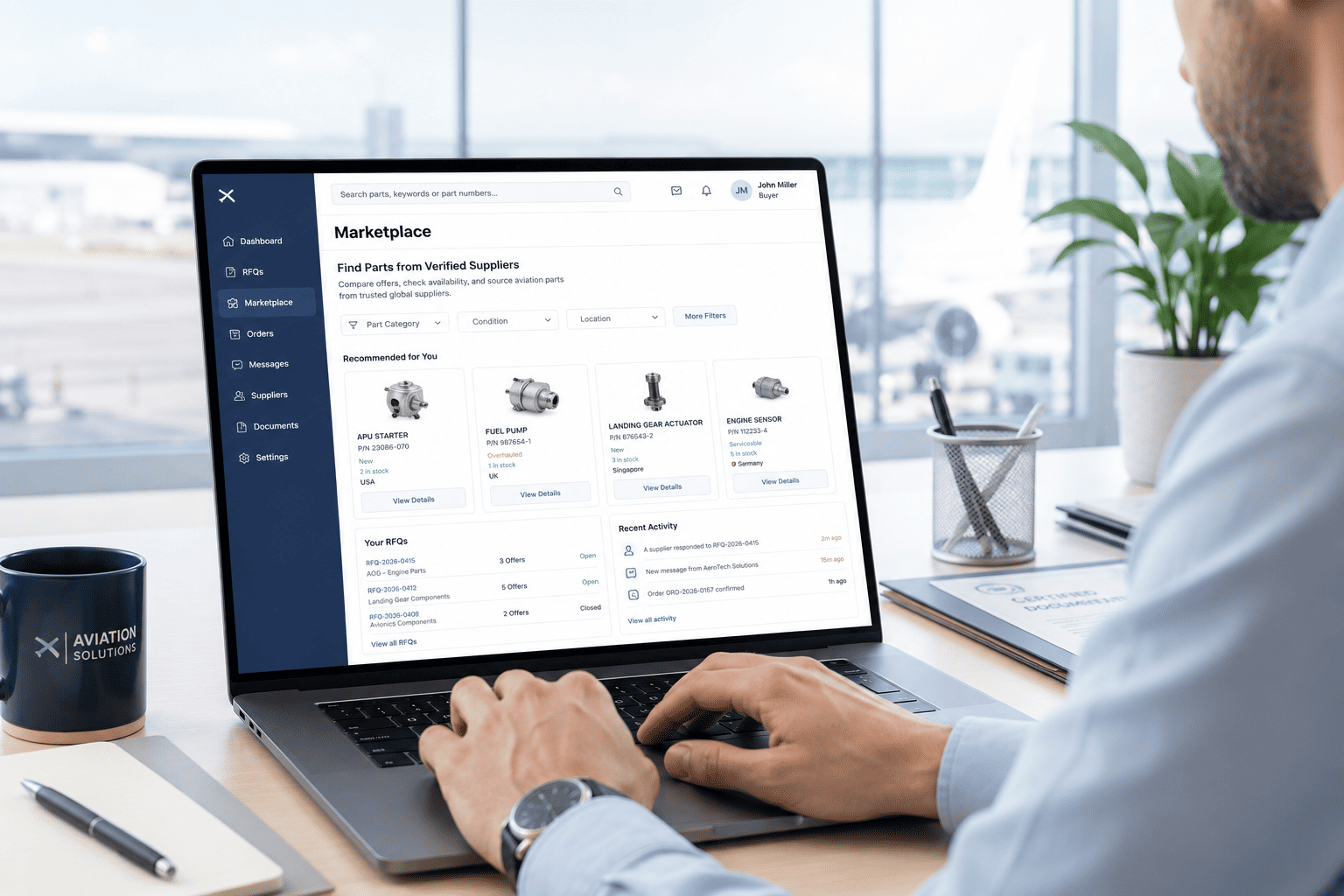
In aviation, certification and traceability are not optional—they are essential. Every aircraft part must meet strict standards set by authorities like the FAA and EASA to ensure safety and compliance. But for many buyers and sellers, understanding documents like FAA 8130-3 or EASA Form 1, and verifying part history, can still feel unclear.
This guide breaks it down in a simple way. You’ll learn how certification works, what traceability really means, and how to avoid unapproved parts—so you can make confident, safe decisions when buying or selling aircraft components.

How to Safely Buy Aircraft Parts Online!
How to Verify FAA / EASA Compliance and Avoid Unapproved Parts
In aviation, trust is everything. Every part installed on an aircraft must meet strict safety and regulatory standards. Whether you’re buying a small component or a major system, certification and traceability are what ensure that part is safe, compliant, and ready to use.
Yet many buyers still face uncertainty when sourcing aircraft parts—missing documents, unclear history, or suppliers they don’t fully trust. These risks can lead to delays, compliance issues, or even serious safety concerns.
This guide explains how aircraft parts certification works, what traceability really means, how to understand key documents like FAA 8130-3 and EASA Form 1, and how to avoid unapproved parts.
If you’re buying or selling aircraft parts, this is knowledge you can’t afford to miss.
Need a part right now? Submit an RFQ on Aviatrading and reach verified sellers worldwide.
What Is Aircraft Parts Certification?
Aircraft parts certification is the process that confirms a component meets airworthiness standards set by aviation authorities.
These standards ensure that every part is:
-
Safe to install and operate
-
Manufactured or repaired correctly
-
Approved under recognized regulations
The main aviation authorities include:
-
FAA (Federal Aviation Administration) – United States
-
EASA (European Union Aviation Safety Agency) – Europe
-
Transport Canada Civil Aviation (TCCA) – Canada
Each authority has its own system, but they all follow the same goal: making sure every aircraft part used in operation is safe and properly documented.
Without proper certification, a part cannot legally or safely be installed on an aircraft.
Understanding FAA 8130-3 and EASA Form 1
Two of the most important documents in aviation parts trading are:
-
FAA Form 8130-3
-
EASA Form 1
These are often called “release certificates” or “airworthiness tags.”
What Do These Documents Prove?
They confirm that a part:
-
Has been inspected, tested, or repaired
-
Meets regulatory requirements
-
Is approved for return to service
When Are They Used?
These documents are issued when:
-
A new part is manufactured
-
A component is repaired or overhauled
-
A part is inspected and approved for reuse
Why They Matter
Without an 8130-3 or Form 1, buyers cannot verify:
-
Where the part came from
-
Who worked on it
-
Whether it meets safety standards
In simple terms, these documents are your proof that a part is legitimate and airworthy.
What Is Traceability in Aircraft Parts?
Traceability means being able to track the full history of a part—from manufacturing to its current condition.
A traceable aircraft part includes clear records such as:
-
Manufacturer details
-
Part number and serial number
-
Maintenance and repair history
-
Previous ownership or usage
-
Certification documents
Why Traceability Is Critical
Traceability helps ensure that:
-
The part is genuine
-
The part has not been altered improperly
-
All maintenance actions are recorded
-
The part complies with aviation regulations
Without traceability, even a certified part can become risky to use.
Source it on Aviatrading
Verified sellers, documentation attached to every listing, and every transaction protected by escrow. You pay only when a deal closes.
The Link Between Certification and Traceability
Certification and traceability go hand in hand.
-
Certification proves a part meets standards
-
Traceability proves where it came from and what it has been through
You need both.
A part with certification but no traceability raises questions.
A part with traceability but no certification cannot be approved.
For buyers, this combination is what builds real confidence in a purchase.
How to Avoid Unapproved Aircraft Parts
Unapproved parts are one of the biggest risks in aviation sourcing. These parts may look correct but lack proper documentation or approval.
Here are the most common warning signs:
Missing Certification
If a part does not have an FAA 8130-3 or EASA Form 1 (when required), it should raise concern immediately.
Incomplete Documentation
Gaps in history, missing serial numbers, or unclear records are major red flags.
Prices That Are Too Low
If a deal seems too good to be true, it often is. Extremely low prices may indicate:
-
Unapproved parts
-
Poor condition
-
Missing traceability
Unknown or Unverified Sellers
Working with suppliers who cannot provide clear information increases risk significantly.
Poor Communication
If a seller avoids questions about certification or documentation, it’s best to move on.

Why This Matters for Buyers
Buying aircraft parts is not just about price—it’s about safety, compliance, and reliability.
Choosing certified and traceable parts helps you:
-
Avoid regulatory issues
-
Reduce risk of installation problems
-
Prevent costly delays or rework
-
Maintain aircraft safety standards
In aviation, one wrong part can have serious consequences. That’s why professional buyers always prioritize documentation and trust over shortcuts.
Why This Matters for Sellers
For sellers, certification and traceability are just as important.
Clear documentation helps you:
-
Build trust with buyers
-
Close deals faster
-
Justify your pricing
-
Reduce back-and-forth questions
Listings with complete documentation always perform better because buyers feel confident moving forward.
How Aviatrading.com Helps Ensure Trust
Aviatrading.com is designed to make aircraft parts trading more transparent and reliable.
We help buyers and sellers connect with confidence by focusing on what matters most in aviation: trust and documentation.
Verified Sellers
We focus on connecting users with professional aviation suppliers who understand industry standards.
Clear Documentation
Listings are structured to include:
-
Certification details (FAA 8130-3, EASA Form 1)
-
Part numbers and serial numbers
-
Condition and traceability information
Direct Communication
Buyers can speak directly with sellers to:
-
Request documents
-
Confirm details
-
Negotiate terms
Transparent Process
No hidden steps, no confusion—just a clear way to source and sell aircraft parts.
Best Practices When Buying Aircraft Parts
To stay safe and efficient, always follow these simple steps:
-
Verify certification documents before purchasing
-
Check traceability and part history
-
Confirm part numbers and compatibility
-
Ask questions and request clarification
-
Compare multiple offers when possible
Taking a few extra minutes to verify details can save you significant time and cost later.
The Shift Toward Digital Aviation Marketplaces
The aviation industry is moving toward more transparent, digital sourcing methods.
Online marketplaces allow buyers to:
-
Access more suppliers
-
Compare options easily
-
Receive faster responses
-
Track communication in one place
This shift helps reduce risk and improves overall efficiency—especially when combined with strong documentation practices.
Build Trust Before You Buy
Aircraft parts certification and traceability are not just technical requirements—they are the foundation of safe aviation operations.
Understanding how certification works, knowing what documents to look for, and recognizing potential risks can help you make better decisions every time you source a part.
Aviatrading.com gives you a platform where transparency, documentation, and direct communication come together—so you can buy and sell aircraft parts with confidence.
Where to buy aircraft parts online: five channels compared
The question is rarely where a part exists. It is which channel gives you the part, the paperwork and a way out if the paperwork is wrong. Five channels, with the trade-off each one carries:
- OEM and authorised distributor. Highest certainty on effectivity and documentation, longest lead time, highest price. The default for life-limited parts and anything driven by an airworthiness directive.
- Independent stockist or redistributor. Strong availability on mature platforms. Quality depends entirely on the individual company’s quality system, so ask directly about ASA-100 or AC 00-56B accreditation before the first order rather than after a dispute.
- B2B marketplace. One structured request reaches many sellers simultaneously. The value depends on two things only: whether sellers are verified, and whether funds are held until the buyer accepts the part. Aviatrading is built this way — verified sellers, documentation attached to each listing, and escrow released on acceptance rather than on shipment.
- Broker. Genuinely useful for hard-to-find items. Understand that a broker usually does not own the part. Establish who holds it, and where, before you commit.
- Open auction and general listing sites. Lowest price, lowest certainty. Trace chains are frequently incomplete and no recourse mechanism exists that was designed for aviation.
The mistakes that cost buyers the most
- Paying in full before inspection. A wire transfer against a photo is not a transaction, it is a hope. Use a channel that holds funds until receipt inspection passes.
- Accepting an image of a tag instead of the tag. Ask for the release document as a file, with the block 12 and block 13 remarks legible, and check that the part number and serial on the tag match the part number and serial on the unit.
- Ignoring effectivity. A correct part number for the wrong aircraft configuration is still a rejected part. Confirm effectivity against the IPC before you commit, not after delivery.
- Treating “certified” as a single thing. An FAA Form 8130-3, an EASA Form 1, a dual release and a manufacturer certificate of conformity are not interchangeable. Which one you need depends on your authority of registration and your maintenance organisation approval.
- Buying on unit price alone. Freight, customs, inspection labour and the cost of a return on a rejected part routinely exceed the price difference that motivated the decision.
- No written condition standard. “Serviceable” means different things to different sellers. State the acceptable conditions in order of preference — NE, NS, OH, SV, AR — in the request itself.
- Skipping shelf life and cure date. Elastomers, seals, adhesives and batteries arrive expired more often than buyers expect. Ask for the date before the part ships.
A five-minute due diligence routine before you release payment
- Confirm the legal entity behind the seller, not just the trading name, and check how long it has been trading in aviation.
- Request the release document and read it, rather than accepting a statement that the part is certified.
- Follow the trace chain end to end and ask about any gap between operators.
- Confirm the return and rejection terms in writing, including who pays return freight on a rejected part.
- Confirm that funds are protected until receipt inspection is complete.
Steps two and three are covered in detail in our guide to verifying aircraft parts certification and the certification and traceability guide.
Why payment protection matters more than seller reputation
Reputation is a lagging indicator. It tells you what happened to other buyers, not what will happen to this shipment. Payment protection is a leading control: if funds are held until the part passes receipt inspection, a documentation failure becomes an inconvenience rather than a loss. That is the reason cross-border aviation trade has moved towards escrow-backed platforms, and it is the mechanism that sits behind every transaction on Aviatrading.

Join a Global Network of Aviation Buyers and Sellers
Opening an account is fast and easy. You can start listing your parts right away or search for the parts you need — all in one secure place. No need to wait. Join Aviatrading today and use a marketplace built to move at your speed.
Sell faster. Buy smarter.
Put your inventory in front of the right buyers right away. Whether you’re selling extra stock or looking for urgent components, Aviatrading gives you real-time access to the market so you can make quick, confident decisions.

Start Sourcing Certified Aircraft Parts Today
If you’re looking for a safer, faster way to source aircraft parts, start by working with trusted suppliers who provide full documentation and clear traceability.
Explore listings, request quotes, and connect with aviation professionals who understand the importance of compliance and trust.
Because in aviation, every part matters—and so does every decision.
AVIATION MARKETPLACE CATEGORIES
Source it on Aviatrading
Verified sellers, documentation attached to every listing, and every transaction protected by escrow. You pay only when a deal closes.