
Need a part right now? Submit an RFQ on Aviatrading and reach verified sellers worldwide.
Used, Serviceable, or New: How Buyers Really Choose Aircraft Parts Today
Is “New” Still the Gold Standard?
For decades, the aviation aftermarket operated on a simple assumption: new parts are always better. If budgets allowed, buyers aimed for factory-new components and treated everything else as a compromise.
Today, that mindset no longer reflects reality.
Rising aircraft utilization, global supply chain disruptions, longer OEM lead times, and increasing cost pressure have forced buyers to rethink how they source parts. Instead of asking “Is it new?”, buyers now ask:
-
Is it available right now?
-
Is it fully traceable and compliant?
-
Does it solve my operational problem without delay?
In many cases, the answer does not point to new parts at all.
This shift has fundamentally changed how aircraft parts are evaluated, purchased, and valued across the industry.
The Three Main Categories of Aircraft Parts Explained
What Are New Aircraft Parts?
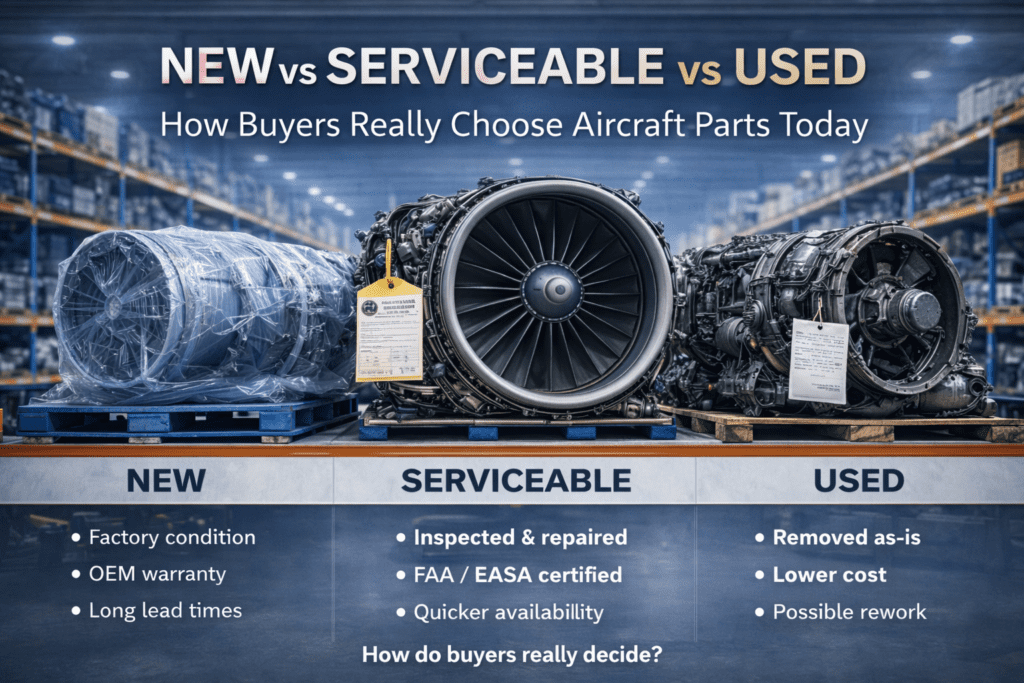
New parts are components that have never been installed or used and typically come directly from the OEM or an authorized distributor.
Key characteristics:
-
Factory-new condition
-
OEM warranty
-
Full documentation and traceability
-
Highest price point
-
Often the longest lead time
When buyers choose new parts:
-
Critical safety components
-
Warranty-driven maintenance programs
-
New aircraft deliveries
-
Strict operator or lessor requirements
However, long production queues and limited allocations mean new parts are often unavailable when urgently needed.


Used and As-Removed Parts: High Risk or Smart Strategy?
Used or as-removed parts are components removed from aircraft without being returned to service yet.
They are typically:
-
Unrepaired
-
Uninspected
-
Sold “as is”
-
Priced lower than serviceable parts
When buyers consider used parts:
-
Immediate teardown sourcing
-
Cost-sensitive repairs
-
Non-critical applications
-
Buyers with in-house repair capability
Used parts can be valuable, but only when buyers understand the condition, history, and potential cost of bringing them back to serviceable status.
What Really Drives Buyer Decisions Today?
Availability and Lead Time Matter More Than Category
In real-world operations, time is often more critical than condition.
During AOG events or tight maintenance windows, buyers prioritize:
-
Parts in stock
-
Immediate shipment
-
Predictable delivery
A serviceable part available today will almost always beat a new part with a 12-week lead time.
Featured snippet opportunity:
What is the most important factor in aircraft parts purchasing today?
Availability and lead time are often more important than whether a part is new, serviceable, or used.
Price Sensitivity Is Higher Than Ever
Maintenance budgets are under constant pressure.
Buyers now evaluate:
-
Cost per flight hour
-
Remaining life
-
Repair vs replacement economics
-
Total lifecycle cost
New parts are no longer chosen by default — they must justify their price.
Documentation and Traceability Can Make or Break a Sale
A perfectly good part without proper paperwork is often unsellable.
Buyers expect:
-
Clear traceability
-
Complete documentation
-
Regulatory compliance
-
Easy access to records
In many cases, documentation quality matters more than physical condition.
Regulatory and Operator Requirements Shape Choices
Different buyers operate under different rules.
-
Airlines follow strict approved parts lists
-
MROs must satisfy multiple customer requirements
-
Lessors focus on asset value preservation
-
Private operators often prioritize flexibility
This diversity means there is no single “best” category — only the best fit for the situation.
Source it on Aviatrading
Verified sellers, documentation attached to every listing, and every transaction protected by escrow. You pay only when a deal closes.
How Buyer Type Influences Part Selection
Airline Buyers
Airlines prioritize:
-
Operational consistency
-
Predictable maintenance planning
-
Approved vendors
-
Reliable supply chains
They often favor serviceable parts with strong documentation, reserving new parts for critical systems or warranty obligations.
MRO Buyers
MROs are highly adaptable.
They choose parts based on:
-
Customer instructions
-
Turnaround time
-
Repair capability
-
Cost targets
MROs commonly source across all three categories, depending on project requirements.
Lessors and Fleet Managers
Lessors think long term.
Their priorities include:
-
Residual value protection
-
Traceability and acceptability across jurisdictions
-
Broad market acceptance
Serviceable parts with complete records are often preferred over new parts with limited availability.
How Digital Marketplaces Changed Buyer Behavior
Online aviation marketplaces have transformed how buyers choose parts.
Key changes include:
-
Side-by-side comparison of conditions
-
Faster access to documentation
-
Transparent pricing
-
Global inventory visibility
Buyers can now evaluate new, serviceable, and used parts simultaneously and make faster, better-informed decisions.
This transparency has accelerated the shift away from category-based thinking.
Myths Buyers No Longer Believe
“New Is Always Safer”
Safety depends on compliance and documentation — not whether a part is new.
“Used Parts Are Risky by Default”
Used parts can be excellent value when properly inspected and traceable.
“The Cheapest Option Always Wins”
Buyers balance price with lead time, paperwork, and reliability.
How Sellers Can Match Real Buyer Expectations
To succeed in today’s aftermarket, sellers must adapt.
Best practices include:
-
Clearly label part condition
-
Provide documentation upfront
-
Price realistically
-
Ensure fast response times
-
Keep inventory visible and accessible
Sellers who improve inventory liquidity gain a real competitive advantage.
The Future of Aircraft Parts Purchasing
The trend is clear.
-
Demand for serviceable parts will continue to grow
-
Speed and availability will dominate decision-making
-
Data-driven sourcing will increase
-
Flexible inventory strategies will outperform static stockholding
Buyers are no longer loyal to categories — they are loyal to solutions.
Buyers Don’t Choose Categories — They Choose Solutions
Modern aircraft parts buyers are pragmatic.
They don’t ask:
-
Is it new, serviceable, or used?
They ask:
-
Will this part keep the aircraft flying?
-
Can I get it now?
-
Is it compliant and traceable?
Understanding this mindset is now essential for anyone operating in the aviation aftermarket.
Those who adapt to how buyers actually choose — not how they used to — will lead the next phase of the industry.
What USM means, and where it comes from
USM stands for used serviceable material: a component removed from an aircraft or engine, inspected, found within limits and released back to service against an approved airworthiness document. It is not scrap and it is not an unapproved part. The entire difference between USM and salvage sits in the paperwork.
Most USM originates in teardown. When an airframe or engine reaches the end of its economic life, a teardown organisation removes the components that still hold value, has them inspected or overhauled by an approved shop, and releases them with an FAA Form 8130-3 or EASA Form 1. The result is a stream of parts that are serviceable, traceable and available in days rather than the months an OEM order can take.
When USM makes the most sense
- AOG. Availability beats lead time. A serviceable unit on a shelf today outperforms a new unit quoted at twelve weeks.
- Out-of-production platforms. Boeing 737 Classic, early A320ceo, ATR, Dash 8 and CFM56-3 fleets are supported largely by USM because new production has stopped.
- Cost-driven programmes. USM typically lands well below new list price, though the discount varies sharply by component category and current market tightness.
- Aircraft near end of lease or end of life. Matching remaining component life to remaining aircraft life avoids paying for life you will never use.
- Rotable pool build-up. Filling a pool with new units is rarely justifiable; filling it with traceable USM usually is.
USM makes least sense on life-limited parts with an incomplete back-to-birth record, on anything a lease return condition explicitly excludes, and where an airworthiness directive demands a modification standard the used unit does not hold.
Where USM availability is strongest
- Engine modules and accessories, including LLPs with complete trace
- Avionics, instruments and displays
- Landing gear and associated actuation
- Structural components and control surfaces
- Electrical and power distribution units
- Cabin interior items, galleys and seating
Rotables dominate the USM market. Consumables and expendables rarely appear, because they are not economic to remove, inspect and re-certify.
What to demand on every USM offer
- The release document itself, not a description of it — 8130-3, EASA Form 1 or dual release
- Removal reason, stated explicitly: removed serviceable, or removed for cause
- TSN, CSN, TSO and CSO figures, and back-to-birth records on any life-limited part
- Modification and service bulletin status against your required standard
- Last operator and the complete chain of custody, with any gap explained
- Shelf life and storage condition for anything with a cure date
Our certification and traceability guide sets out what a complete trace chain should contain, and how to verify aircraft parts certification covers the document checks themselves.
The sustainability case for USM
Reusing an existing component avoids the raw material extraction, forging, machining and transport embedded in a new one. For operators reporting against emissions targets, USM is one of the few procurement decisions that reduces cost and reported footprint at the same time. Teardown and reuse are the practical form the circular economy takes in aviation.
Verified USM listings with documentation attached are available on Aviatrading, and buyers can post a requirement directly through an RFQ.
Source it on Aviatrading
Verified sellers, documentation attached to every listing, and every transaction protected by escrow. You pay only when a deal closes.