
Need a part right now? Submit an RFQ on Aviatrading and reach verified sellers worldwide.
Introduction
The aviation industry has made significant progress since the disruptions of recent years, but supply chain challenges remain a major concern for airlines, MRO providers, and aircraft parts suppliers. While passenger demand and flight activity continue to increase worldwide, the availability of critical aircraft components has not fully recovered to meet industry needs.
In 2026, aviation organizations continue to face aircraft parts shortages, extended OEM lead times, rising procurement costs, and increasing pressure to minimize aircraft downtime. These challenges affect every stage of the aviation supply chain, from manufacturers and distributors to procurement teams and maintenance providers.
Understanding the key factors behind today’s supply chain environment is essential for organizations seeking to improve sourcing efficiency, reduce operational risk, and maintain fleet readiness.
Why Aviation Supply Chain Challenges Persist
Many industry professionals expected supply chain conditions to stabilize as global markets recovered. However, aviation remains uniquely vulnerable to disruptions due to the complexity of aircraft manufacturing, strict certification requirements, and the highly specialized nature of aerospace components.
Aircraft parts often require lengthy production processes, extensive quality control procedures, and regulatory approvals before they can enter service. Even small disruptions can create delays throughout the supply chain.
Several factors continue to contribute to ongoing challenges:
- Increased global flight activity and fleet utilization
- Manufacturing backlogs across aerospace suppliers
- Labor shortages in production and maintenance sectors
- Limited availability of raw materials and electronic components
- Growing demand for replacement parts and engine components
As a result, procurement teams frequently face longer sourcing cycles and reduced inventory availability.

Source it on Aviatrading
Verified sellers, documentation attached to every listing, and every transaction protected by escrow. You pay only when a deal closes.
Aircraft Parts Shortages Continue to Impact Operations
One of the most significant challenges in 2026 remains the ongoing aircraft parts shortage affecting commercial and business aviation.
Although inventory levels have improved in some areas, many operators continue to experience difficulties sourcing critical components. Certain categories remain particularly affected:
- Engine parts
- Avionics equipment
- Landing gear components
- Structural assemblies
- Electrical systems
- Consumables and hardware
For airlines and MRO providers, these shortages can create operational disruptions, delayed maintenance events, and increased costs.
In some cases, maintenance teams may spend days or even weeks searching for available inventory across multiple suppliers. This increases administrative workload and can delay aircraft return-to-service timelines.
The challenge is especially significant for older aircraft platforms where parts availability is already limited and production volumes are lower.
Extended OEM Lead Times Remain a Major Concern
Another critical issue affecting aviation procurement is the continued extension of OEM lead times.
Original Equipment Manufacturers continue to face strong demand while managing production constraints and supplier dependencies. As a result, lead times for many aircraft components remain significantly above historical averages.
For procurement professionals, longer lead times create several challenges:
- Reduced planning flexibility
- Increased inventory carrying costs
- Greater exposure to unexpected maintenance events
- More frequent urgent sourcing requirements
Organizations that previously relied almost exclusively on OEM procurement are increasingly exploring alternative sourcing strategies, including approved aftermarket suppliers and global inventory networks.
The ability to identify alternative sources quickly has become an important competitive advantage in today’s market.
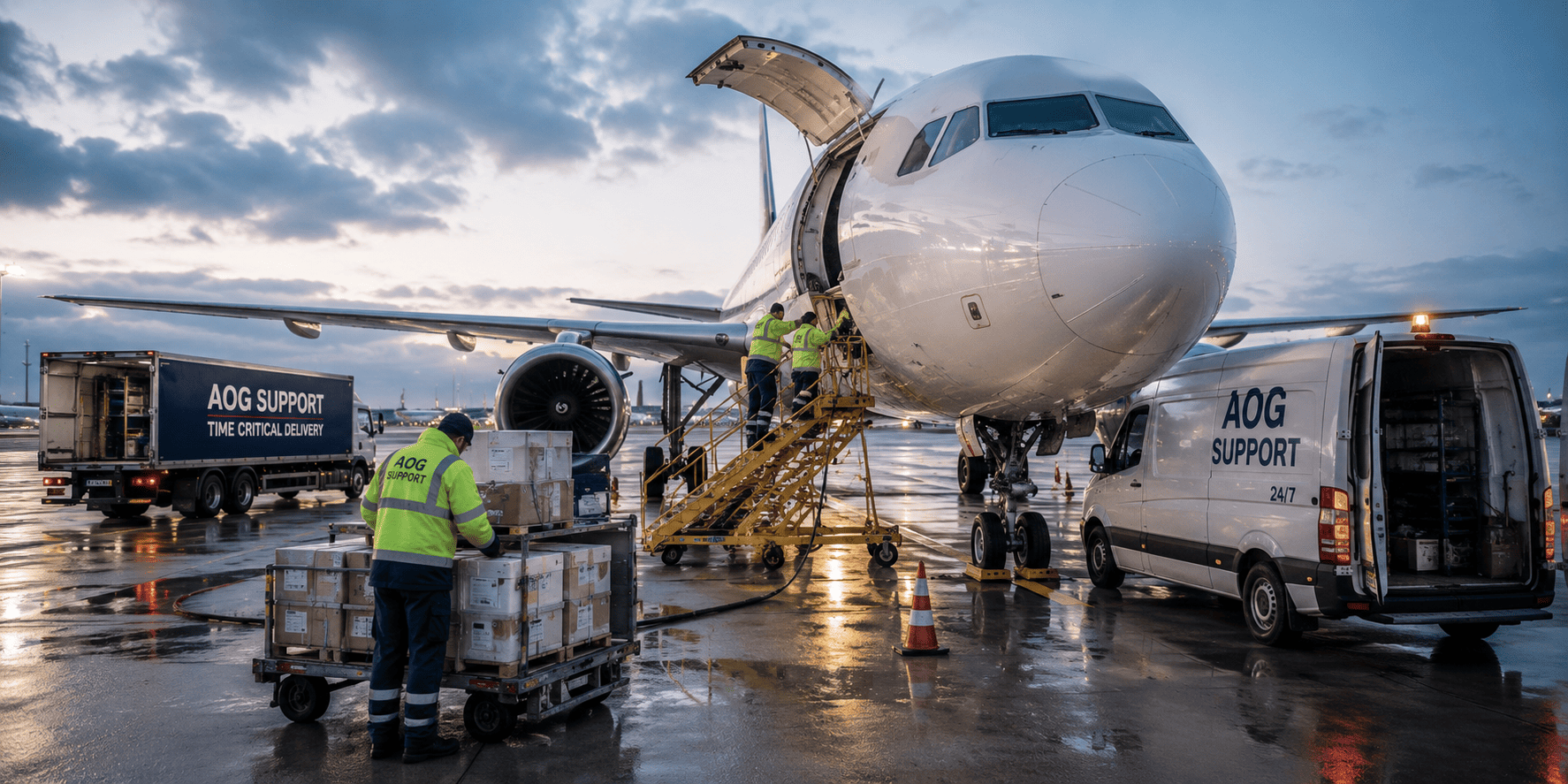
Growing Pressure on AOG Support
Aircraft on Ground (AOG) situations represent one of the most expensive operational challenges in aviation.
When an aircraft cannot operate because a required component is unavailable, airlines face immediate financial consequences. Flight cancellations, schedule disruptions, passenger compensation, and operational inefficiencies can quickly generate substantial costs.
Because of this, AOG support has become an increasingly important part of aviation procurement strategies.
Successful AOG response depends on several factors:
- Fast access to available inventory
- Reliable supplier networks
- Efficient logistics coordination
- Real-time communication between buyers and suppliers
- Rapid quotation and approval processes
The difference between locating a part in a few hours versus several days can have a major impact on operational performance.
Many organizations are therefore investing in digital sourcing tools that help procurement teams identify available inventory more quickly during urgent situations.
Inventory Visibility Remains a Challenge
In many cases, aircraft parts are available somewhere in the market—but buyers simply struggle to find them efficiently.
The aviation supply chain remains highly fragmented. Inventory is distributed across OEMs, distributors, repair stations, brokers, airlines, and independent suppliers located around the world.
Without centralized visibility, procurement teams often spend significant time:
- Contacting multiple suppliers
- Requesting availability information
- Comparing offers manually
- Verifying certifications
- Evaluating delivery timelines
This fragmented process slows decision-making and increases sourcing costs.
As aviation procurement becomes increasingly digital, companies are placing greater emphasis on platforms and technologies that improve inventory visibility and simplify supplier discovery.
Better access to market information enables procurement teams to make faster and more informed purchasing decisions.
Rising Complexity in Aviation Procurement
The process of aviation procurement has become significantly more complex over the past several years.
Finding a part is no longer the only objective. Buyers must also evaluate a range of additional factors before making purchasing decisions.
These factors include:
- Supplier reliability
- Traceability documentation
- Airworthiness certifications
- Geographic location
- Shipping timelines
- Repair versus replacement options
- Total acquisition cost
As supply chain conditions become more unpredictable, procurement professionals are expected to balance cost, speed, compliance, and operational requirements simultaneously.
Organizations that rely on manual sourcing methods may find it increasingly difficult to keep pace with market demands.
Modern procurement teams are therefore adopting more data-driven approaches that support faster sourcing decisions and improved supplier management.
How Aviation Companies Are Adapting
Despite ongoing challenges, aviation organizations are actively implementing strategies to improve supply chain resilience.
Some of the most effective approaches include:
Expanding Supplier Networks
Companies are reducing dependency on a small number of suppliers by building relationships with a broader range of inventory sources.
Increasing Strategic Inventory
Many operators are maintaining higher stock levels for frequently used components to reduce exposure to shortages.
Leveraging Digital Marketplaces
Online aviation marketplaces help buyers identify suppliers, compare offers, and submit RFQs more efficiently than traditional sourcing methods.
Improving Demand Forecasting
More accurate forecasting allows organizations to anticipate maintenance requirements and secure inventory before shortages occur.
Diversifying Procurement Channels
Successful procurement teams increasingly combine OEM sourcing, aftermarket suppliers, repair solutions, and marketplace inventory to improve flexibility.
Looking Ahead
Supply chain conditions in aviation continue to evolve, but challenges are unlikely to disappear in the near future.
Aircraft parts shortages, extended OEM lead times, and increasing procurement complexity will remain important considerations throughout 2026 and beyond.
Organizations that prioritize supply chain visibility, supplier diversification, and agile sourcing strategies will be better positioned to respond to market disruptions and maintain operational efficiency.
While no single solution can eliminate supply chain risk entirely, companies that embrace modern procurement practices and leverage broader supplier networks can significantly improve their ability to secure inventory when it matters most.

Conclusion
The aviation supply chain remains under pressure in 2026. Continued aircraft parts shortages, long OEM lead times, and growing demand for effective AOG support are creating challenges for airlines, MRO providers, and procurement teams worldwide.
However, organizations that invest in stronger supplier relationships, improved inventory visibility, and more efficient sourcing processes are finding ways to navigate these challenges successfully.
As the industry continues to grow, supply chain resilience will remain one of the most important competitive advantages in aviation procurement.
What a reliable aircraft parts supply chain actually looks like
Challenges are easier to list than to fix. The operators who feel them least have usually built the same six things, in roughly this order:
- A qualified supplier list, built before it is needed. Accreditation status, quality system, average response time and dispute history recorded in advance. Vetting under AOG pressure is vetting badly.
- One written documentation standard. Which release documents are acceptable, what depth of trace is required, and who signs off an exception. Without this, every purchase becomes a negotiation.
- Inventory visibility across the network. Own stock, pool stock, consignment stock and sister-fleet availability in one view. A surprising share of urgent purchases duplicate a part the operator already owns.
- Dual sourcing on anything that grounds an aircraft. Single-source dependency is a lead-time risk disguised as a commercial relationship.
- Lead-time commitments written into contracts, with an agreed escalation path rather than a phone number.
- Payment terms that protect both sides. Escrow release on acceptance removes the standoff that slows cross-border transactions between counterparties who have never traded before.
How operators and MROs are adapting
- Broadening the approved source base beyond OEM and authorised distribution, to include qualified independents, teardown suppliers and marketplaces where sellers are verified.
- Designing USM into the plan rather than treating it as a fallback. On mature platforms, used serviceable material is frequently the primary route, not the emergency one.
- Holding safety stock selectively — on the specific part numbers that historically ground aircraft, rather than uniformly across the catalogue.
- Pooling and consignment at line stations, moving inventory closer to where the aircraft actually stops overnight.
- Shortening the quote cycle by broadcasting structured requests to many verified sellers at once instead of calling suppliers in sequence.
Designing AOG resilience into the supply chain
AOG response is where supply chain weaknesses become visible and expensive. The controls that reduce AOG duration are all upstream: pre-qualified sellers, an agreed condition and documentation standard, rotable pool coverage on grounding parts, and consignment stock at the right stations. Operators who put these in place do not eliminate AOG events — they convert a two-day event into a six-hour one. The practical sequence is set out in our guide to finding aircraft parts fast during AOG.
To reach verified sellers across all of these routes in a single request, post the requirement as an RFQ on Aviatrading.
Source it on Aviatrading
Verified sellers, documentation attached to every listing, and every transaction protected by escrow. You pay only when a deal closes.